

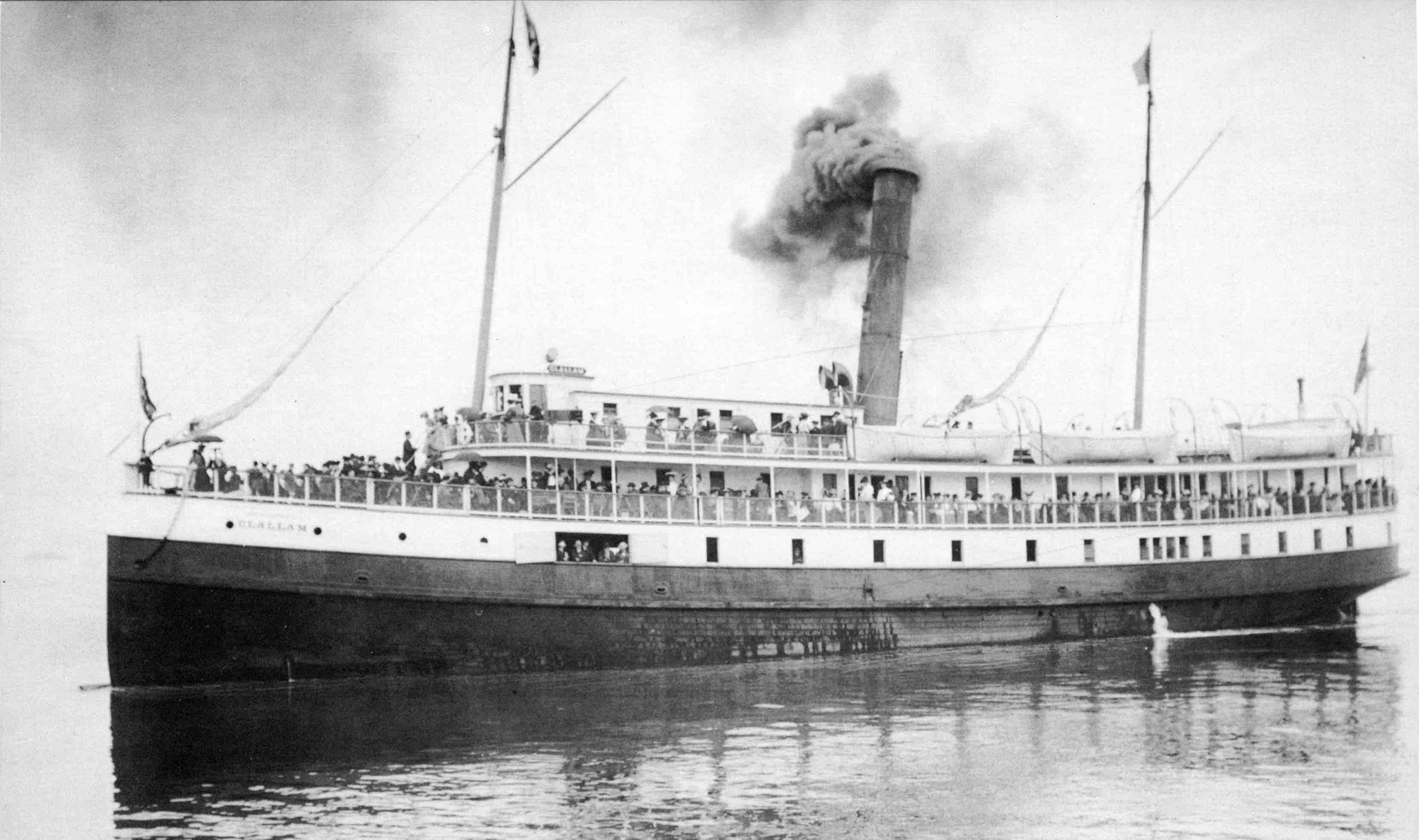
Off the coast of the Salish Sea, opposite the southern shores of Vancouver Island, on the American side of the border, in the northern part of the Olympic Peninsula in Washington State, resides the proud indigenous Klallam people. In their language, Klallam means "strong people". However, this story is not about a proud First Nation or even about strong people. This is a story about human weakness, human mistakes, and human tragedy.
The Pearl of the Black Ball
At the beginning of the 20th century, a ferry company was growing in prominence in the Salish Sea region. Based in Seattle, Washington, this company would eventually become the key transporter in these waters: the Puget Sound Navigation Company (PSNC), also known under its operator brand as the Black Ball Ferry Line (BBFL). As its name suggests, for those familiar with the area, the company provided ferry transportation across the Puget Sound—a complex network of funnel-shaped interconnected waterways leading from the southern basin of the Salish Sea through the Strait of Juan de Fuca to the Pacific Ocean.
For a time, the company expanded by merging with or acquiring competitors, forming the initial fleet of the Black Ball brand. However, in 1903, the company took a bold step forward by constructing its first own ship.
This first ship was meant to be the pride of PSNC, its jewel, its pearl. The construction cost amounted to $80,000 (equivalent to over CAD 4,000,000 in today’s value). The vessel was state-of-the-art for its time, built from local Douglas fir (which has become a regional symbol). It measured 168 feet (51 meters) in length, 32 feet (10 meters) in width, and had a hold depth of 13 feet (4 meters), with a displacement of 657 tons. Its screw-driven propulsion system, powered by an 800-horsepower (600 kW) engine, enabled a speed of 13 knots (24 km/h). The vessel had 44 cabins, accommodated 250 passengers, and was served by a crew of 31. While these dimensions might not impress modern readers, it’s worth remembering that Columbus reached America aboard the Santa Maria, which was three times smaller.
Built at the Edward Heath shipyard in Tacoma, Washington, the steamship Clallam was launched on April 15, 1903, and made its maiden voyage on July 3 of the same year. Together with another steamer, Majestic, the Clallam was designed to serve the Seattle–Port Townsend–Victoria route.
An Ominous Beginning
From the very beginning, the maritime gods did not favor Clallam. During its launch ceremony, the woman assigned to christen the ship with a bottle of champagne swung and… missed. When the ship’s flag was hoisted on the mast, it was accidentally raised upside down. According to maritime superstitions, these were clear omens of misfortune.
But business is business, and no amount of superstition could halt operations. The ship set sail on its designated route, transporting people, goods, and livestock. July passed, then August, followed by autumn and Christmas… and soon came the new year of 1904.
The Stubborn Judas Sheepcariot
On the morning of the 8th of January at Pier No. 1, at the foot of Yesler Way—a street that divided (or, if you prefer, united) two historically distinct sections of Seattle’s port—it was as bustling as ever. However, above the sounds of scraping, creaking, and chatter, the loudest noise was the bleating of sheep. As usual, local farmers were herding sheep from the mainland to Vancouver Island to sell them for a hefty profit in the frozen capital of the Pacific province.
The latest flock, though constantly bleating, obediently followed Judas—a trained lead sheep with a large bell around its neck. Like rats following the sound of a flute, the sheep loyally clanked along behind Judas. But suddenly, Judas stopped dead in her tracks and flatly refused to board the ship. The stubborn sheep was as stubborn as a sheep. With no way to persuade her, the crew had to leave Judas on the dock.
Whether the lone animal bleated or remained silent, no one knows—the bustling port swallowed up her presence. No one will ever recall the heavy, fate-sealing gaze of this Moirai in the shape of a sheep, watching as the steamship Clallam disappeared into the morning fog at 8:30 AM.
Post-New Year’s Siesta of a Tarnished Captain
According to the schedule, the steamer under the command of George Roberts—a 55-year-old captain with 29 years of experience (and a somewhat stained reputation, which had effectively relegated him from the Pacific coast of Alaska to the ferry-bound purgatory of pre-retirement drudgery)—sailed through the inlets of Puget Sound and arrived in Port Townsend, the midpoint of its route. There, it passed customs inspection and at precisely 12:15, set course northward, crossing the Strait of Juan de Fuca toward Victoria.
At that very moment, the mythical Hypnos lulled two beings from different worlds into a drowsy afternoon slumber. The first was Captain Roberts, who, after Klallam’s departure from Port Townsend, had retired to his cabin for some much-needed rest.
The second was Eurus, the eastern morning wind, who had also dozed off briefly, only to stir again by noon. Normally, Eurus made his presence known much earlier—right at the winter solstice—but on that particular day, he disregarded the calendar altogether. Evidently, his dreams had been less than pleasant, for when he awoke, the wind in the Salish Sea straits doubled in strength—from 36 to 60 miles per hour (or from 58 to 97 km/h). Soon enough, the storm had grown fierce enough to rouse even Captain Roberts from his nap, as the ship trembled and listed unnaturally in the angry waters.
Outpacing the Olympians
A few years later, in 1908, men’s race walking would become an official Olympic sport. But the crew of the Klallam was already far ahead of the International Olympic Committee in this regard. But first, let us return to the beginning.
When the storm suddenly struck the Strait of Juan de Fuca on the afternoon of January 8, 1908, the Klallam’s bridge was under the temporary command of First Officer George W. Doney, as the captain was still absent. When the groggy Captain Roberts finally stumbled into the wheelhouse, the chief engineer, Scott A. Deloney, had just called from the engine room, reporting, “A storm wave has shattered a porthole in the engine room—one that had already been patched before, though evidently not very well—and the ship is taking on water.”
Trying to orient himself in this unsettling reality, Captain Roberts dispatched his first officer to confirm the situation firsthand. And what do you suppose the first officer found? Indeed, he discovered that “a storm wave had shattered a porthole in the engine room—one that had already been patched before, though evidently not very well—and the ship was taking on water.” Eureka!
After personally verifying the truth of this unfortunate report, Engineer Deloney decided to stretch his legs as well. Accompanied by George W. Doney, he made his way to the bridge to once again inform Captain Roberts of the unfolding disaster in person. The engineer formally reported: “A storm wave has shattered a porthole in the engine room—one that had already been patched before, though evidently not very well—and the ship is taking on water.” The first officer confirmed, “Indeed, a storm wave has shattered a porthole in the engine room—one that had already been patched before, though evidently not very well—and the ship is taking on water.”
And what do you think Captain Roberts did, now that reality had firmly asserted itself? Without burdening himself with excessive contemplation, the captain, too, decided to engage in a bit of race walking and descended toward the engine room. However, he only made it halfway before realizing that the space was already flooded waist-deep because… well, a storm wave had shattered a porthole in the engine room—one that had already been patched before, though evidently not very well—and the ship was taking on water.
The Lights Went Out
What could be done? The responsibility fell to the engineering crew. And what did they do? Disregarding official protocols for dealing with such crises, and guided by a flash of inspiration, they attempted to plug the hole with blankets, stuffing them into the breach and securing them with nailed planks. But as it turned out, blankets were of little use against the fury of a storm on the open sea.
Only then were the pumps activated. But it would have been better if they hadn’t been. The Klallam’s pumps were either malfunctioning, clogged with debris, or perhaps Chief Engineer Deloney operated them in an ‘original’ (read: incorrect) manner, for instead of expelling water from the ship, the pumps redirected more water into the engine room.
And the emergency pumps? This is the moment to summon all your faith, for it may be difficult to believe—but… the emergency pumps had failed as well.
By around three in the afternoon, the water had risen high enough to extinguish the boiler fire, leaving the ship without light.
People Are More Fearsome Than the Elements
At approximately 3:30 p.m., Captain Roberts suspected that the ship would not stay afloat much longer. He ordered the lifeboats lowered. Almost all of the women and children aboard were placed in them. However, though the first boat carried four crew members and an experienced merchant officer, the other two lacked anyone with the skills to navigate them. And in the end, panic and poor decisions led to one of the most horrifying tragedies in the history of the Salish Sea…
As the second boat was lowered and filled with terrified women and children, just as it was about to push off from the side of the sinking ship, a crew member, maddened by fear, suddenly shrieked, “God, this boat isn’t leaving without me!” He leapt from the deck, landing with a crash inside the overcrowded lifeboat. His heavy boots struck the skull of one of the women, killing her instantly. And as if that weren’t enough, the man panicked, rocked the boat violently, and capsized it. The small vessel sank instantly into the stormy sea.
A young mother from the overturned boat somehow managed to surface near the side of the steamer, holding her infant above the waves with outstretched arms. A man on deck scrambled down a rope just in time to snatch the baby from her grasp before the next wave dragged her beneath the surface.
Many men still on board watched helplessly as their wives and children drowned. Among them was a young groom who had set out on his honeymoon, forced to witness his beloved vanish into the depths.
Before long, all three lifeboats had overturned, and nearly all those aboard—almost entirely women and children—perished. Within minutes, at least 54 people had lost their lives.
The survivors who remained on the sinking ferry, in sheer desperation, began bailing out water by hand, bucket by bucket, without stopping—for the rest of the evening, through the entire night, until the dawn of Saturday, January 9th…
Unlucky Clallam
Clallam was supposed to arrive in Victoria around four in the afternoon, and despite its misfortune—despite the catastrophe—it came achingly close to reaching safe harbor.
At a quarter to four, Mr. E.E. Blackwood, the local agent of the PSNC, stood at Clover Point, gazing out over the stormy waters. Suddenly, through the chaos of the waves, he spotted a steamship drifting helplessly near the mouth of Victoria's harbor, its engines lifeless. About four miles southeast, near Trial Island, the vessel floundered—adrift, at the mercy of the storm.
Blackwood raced to the nearest telephone. A tug had to be dispatched at once. But there were none. He called one after another—the first, the second, the third, the fourth—but none were within reach. The smaller tugs nearby were powerless against the fury of the storm; they would never manage to aid a vessel of Clallam's size.
Meanwhile, around five in the evening, the southwesterly wind—winged Notus, known as the "terrible"—drove the Clallam eastward toward the San Juan Islands and Lopez Island.
Later, the steamer was spotted near Discovery Island at the entrance to Rosario Strait. Reports indicated that despite the storm, the ferry was sailing under sail toward Port Townsend.
At seven in the evening, Mr. H.L. Tibbats, the local agent of PSNC, received a distressing telegram. In response to the call for help, two company tugboats—Richard Holyoke and Sea Lion—were immediately dispatched from Port Townsend. Around half-past seven in the evening, the tugs set out into the storm.
Meanwhile, Mr. Blackwood managed to enlist the steamer Iroquois, under the command of Captain Albert A. Sears, to join the search. The Iroquois departed from Sidney, BC, heading toward San Juan Island, surveying its coastline all the way to Cattle Point, but found no sign of the vessel or any signal lights.
Afterward, the steamer circled Smith Island, scanning the shore and surrounding waters, but there was no trace of the Clallam. Following a fruitless search in the raging sea, around 11 p.m., the Iroquois was forced to return to Sidney. However, before heading back, Captain Sears spotted one of the two tugboats from Port Townsend in the distance. The only hope left was that the second tug had managed to locate the Clallam.
Rescue and... Sinking
Indeed, Neptune finally took pity on the unfortunate souls. At approximately 10:35 PM, somewhere between Smith Island and San Juan Island, the steam tug Richard Holyoke, under the command of Captain Robert Hall, finally located the sinking Clallam. The rescuers managed to throw a towline aboard the Clallam and take the steamer under tow. Although Victoria was closer, the weather conditions forced them to head toward the American shore instead.
Around 1:00 AM, the tug Sea Lion joined them. But Clallam was dying. Captain George Roberts knew it—knew that in moments, the sea would swallow his ship whole. He tried to signal the Holyoke to cut the line, to sever the connection before the sinking ship dragged its rescuer into the abyss. But the tug misunderstood his desperate signals. Left with no choice, Clallam’s crew severed the towline themselves... Within mere minutes, Clallam capsized and sank at approximately 1:15 AM.
The tug crews immediately launched a rescue operation plunging into the freezing waters to pull survivors from the wreckage. One of them was Edward D. Hickman (1876–1928), who was serving as the first mate of Holyoke. He bravely jumped into the icy waters and personally rescued 15 people. This incredible act of heroism, however, came at the cost of his health.
Thanks to Hickman’s courage and the efforts of the other rescuers, nearly all those who had remained aboard the sinking Clallam were saved—a total of 36 people!
Fate of the Guilty
The Steamboat Inspection Service launched an inquiry. The findings were grim. Clallam had lacked the required distress flares—just one of many failures in a system riddled with neglect. The investigation triggered widespread inspections, revealing an unsettling number of unseaworthy vessels.
Shortly after, Joshua Green, the head of the Puget Sound Navigation Company at the time, purchased much more reliable steel steamers—the Indianapolis, Chippewa, and Iroquois. However, before these newly acquired vessels could reach Puget Sound—having to travel all the way from the Great Lakes via the Strait of Magellan—Clallam’s route was taken over by the Alaskan Steamship Company. Initially, they operated the ferry Dolphin, and later, Majestic—a twin vessel to Clallam—which was rebuilt and renamed Whatcom.
The Steamboat Inspection Service also revoked the license of Engineer De Lonne and suspended Captain George Roberts’ license.
Meanwhile, after several weeks of witness testimony hearings, the Victoria court found Captain Roberts guilty of manslaughter for the deaths of at least 21 people (whose bodies were recovered and identified). A warrant was issued for his arrest, and the U.S. considered extraditing him to Canada. However, Roberts never left the U.S., never returned to the sea, never went back to his home in Victoria, and never paid for the lives lost on that fateful night. Hiding from justice, he died in Seattle, Washington, in August 1915.
The death toll could have been even worse, as the ferry—designed to carry 250 people—was only one-third full. Yet even so, of the 92 people aboard—31 crew members, 61 passengers—at least 56 perished, including several children whose names were never recorded.
It was the deadliest maritime disaster in the history of the Salish Sea.


